
To achieve its vision, BUILDSPACE is based on short iterative cycles of work, with highly parallel streams of activities by adopting a SCRUM-like software engineering methodology with a view to guarantee a well-defined time to market context. As such, BUILDSPACE considers continuous integration during the project lifetime, and the adoption of the DevSecOps strategy since the beginning of the project and throughout the project testing, validation, and exploitation, ensuring agile long-term evolution.
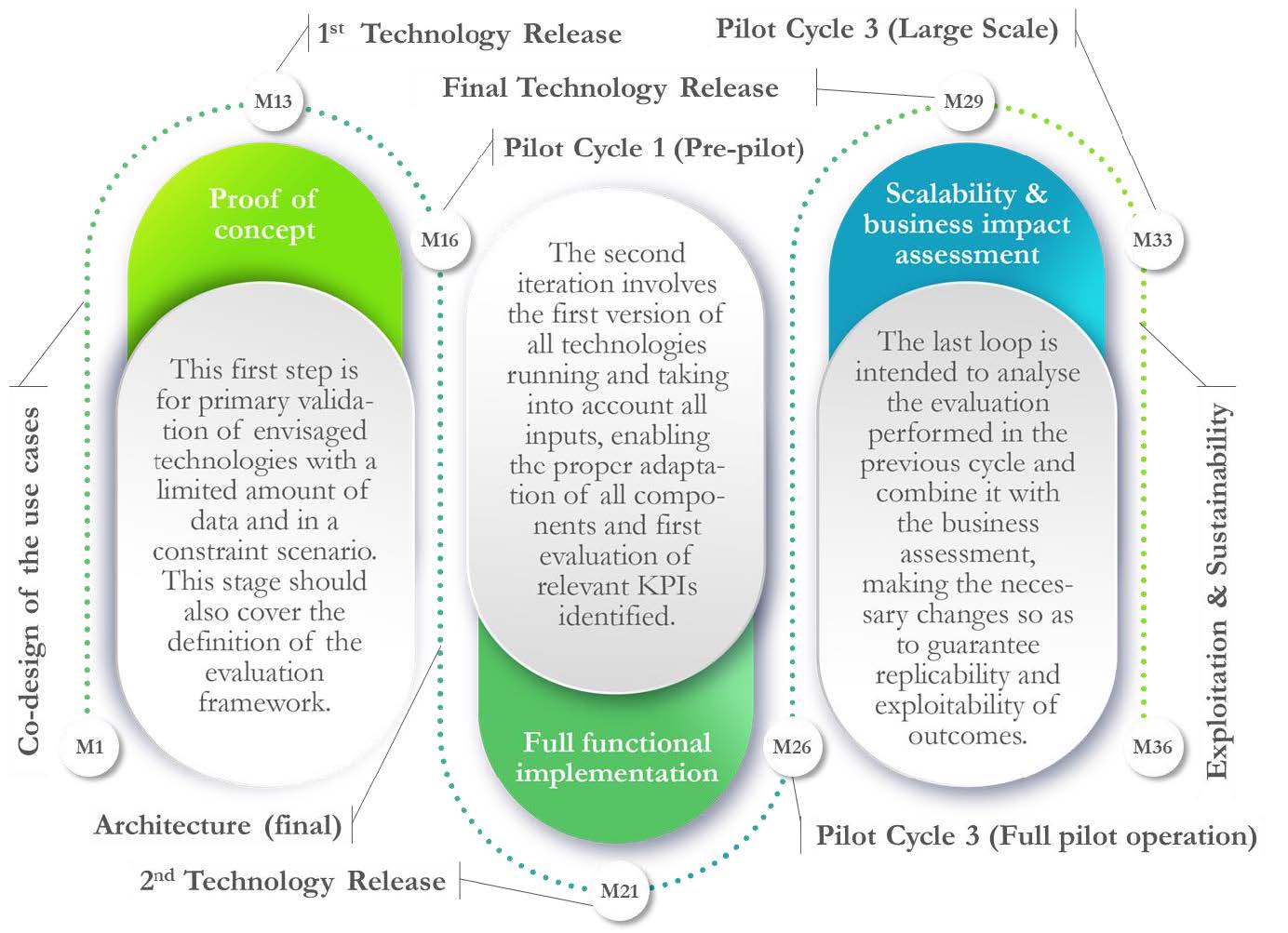
Each phase feeds the next one, so that an initial, intermediate, and final version of the project framework and related tools will be derived after the end of every phase. A full development cycle is implemented in each phase:
Phase 1 || Specification & Technologies adaptation M1-M16
It will include the co-design and co-creation of the scenarios, use cases, the elicitation of user requirements and system requirements, dynamic assessment, modelling and definition of system architecture. The BUILDSPACE development processes will start by collecting insights through users’ /stakeholders’ activities i.e. based on review of reference scenarios and user stories about innovative EGNSS and Copernicus based solutions for energy-efficient buildings, as well as based on the analysis of the project’s pilots. This phase will be complemented by information from linked research initiatives, such as flagship data and energy-efficient buildings projects from partners, relevant standards, as well as project-specific, pilots and data assets requirements, and will be further analysed through requirements engineering techniques. The outcome of this activity will be a set of requirements, each split into a set of prioritised functionalities for the BUILDSPACE development activities, as needed for enhancing the project’s technology capabilities and conducting the pilots. Early technology and asset assessment will be followed by preliminary validation of key solution ideas in local, existing small-scale pilot-site infrastructure deployed along a subset of pilot sites. Early data-driven experimentation will be carried out, through proof-of-concepts and early technologies probes for a subset of prioritised technology micro-services components and will be used for exploratory experiments with selected data pinpointing problems and opportunities for ‘quick-win’ data value generation. At the building level, it is especially important to define models that consider not only energy aspects but also thermal, visual, acoustic comfort information. To do that it is necessary to have a lot of data to test the algorithms and create possible scenarios. This data is not always available, so introducing possible campaign on pilots to monitor comfort aspects could be helpful to increase the number of data available. The concept will be fine-tuned, while architectures and blueprints for building location-based and remote sensing applications in the sector of buildings will be consolidated, in order to drive developments in all core technology WPs 3-4.
Phase 2 || Product Integration & Fine Tuning M17-M26
Based on feedback from Phase 1, the scenarios and requirements will be refined, and a second implementation of advanced functionalities for technological components will be released (M21). This phase will focus on the delivery of all the technological enablers and on their deployment on the pilot sites. Hence a second pilot validation campaign (First Pilot Operation Phase) will be performed, based on first release of all the technology enablers of the project’s concept. BUILDSPACE complete framework will be hence deployed at pilot site through controlled environments, decoupled from ‘production’ environments, with the use of a dedicated data processing infrastructure for experimental purposes exploiting learning large historic and live data, possibly anonymised or simulated. Beyond full deployment of BUILDSPACE framework and enablers, first standardisation and certification efforts to match data governance structures with a rich KPI collection and benchmark analysis will be performed. BUILDSPACE components will be evaluated (M22-M26), during the full pilot operation phase, for both usability and performance levels.
Phase 3 || Product Assessment & Market Uptake M27-M36
This phase will take into consideration the evaluation results of Phase 2 with a view to enable the refinement of component and system level technology consolidation, through scalability-driven functionality enhancements using the final versions of the BUILDSPACE enablers. Overall, the final version of BUILDSPACE will have been concluded latest by M29, resulting in the final version/iteration of the relevant deliverable in WP3. A final pilot validation will be carried out mostly focused on the scalability and will provide the necessary benchmark to perform the business validation based on a techno-economic assessment of the business benefits gained by each pilot. Following this assessment, components with the highest maturity and market readiness will be prioritised for exploitation, commercialisation and wider use.
In parallel to the above three phases, we will coordinate with EGNSS and Copernicus, and other related projects, in order to align better our architecture and identify requirements. More specifically, we envisage a multi-level interaction and alignment with EGNSS and Copernicus, as follows:
From EGNSS/Copernicus to BUILDSPACE
- Requirement level: We will build BUILDSPACE use cases in a way that full compliance to the EGNSS and Copernicus requirements will be guaranteed.
- Data/Services level: We will explore available services to discover, manipulate, process and download EGNSS/Copernicus data and information, such as DIAS (Data and Information Access Services).
- Accelerators level: We will leverage on the accelerators as made available by EGNSS and Copernicus for our ecosystem building activities with a view to accelerate the technology transfer of the BUILDSPACE knowhow through the EGNSS and Copernicus innovation ecosystem.
From BUILDSPACE to Copernicus/DestinE
- We will have a dedicated task in the work plan “Task 5.3. Leveraging and complementing the Copernicus/DestinE” led by ECWMF that will investigate potential contributions of the project to Copernicus services and DestinE programme with emphasis on Digital Twins technologies and Data Federation aspects.
